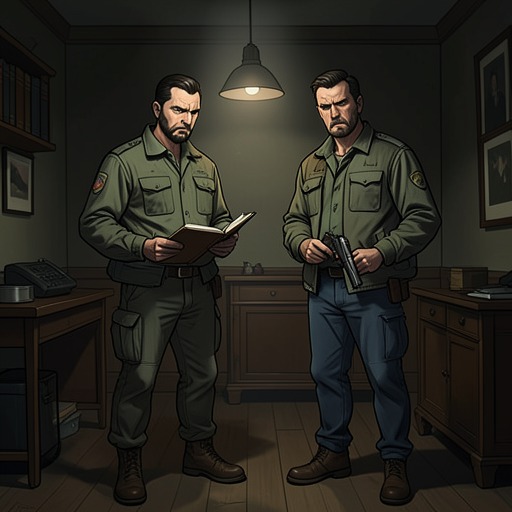
Gus Landor's appointment to investigate the Fry case
The Pale Blue EyeAugustus Landor’s appointment to investigate the Fry case begins as a request to find whoever took Leroy Fry’s heart, but Landor challenges the question embedded in that request. At Ward B-3, with Fry’s body still before him, he asks whether the United States Military Academy at West Point wants him to discover who removed the heart or who hanged Fry. The distinction makes the appointment more than an assignment to solve a gruesome desecration: it raises the possibility that the apparent hanging itself was a murder disguised as suicide.
Mandate and Institutional Stakes
Sylvanus Thayer makes the appointment against the interests of his own career. He tells Landor that his career means little beside the Academy’s survival and that, if he could be sure it would endure, he would leave West Point the next day. The remark places the investigation within an institutional crisis: the death of a cadet and the violation of his body threaten not only the family or fellow students but the standing and future of the school.
Thayer describes Fry as having died young and by his own hand, then condemns the offense against his defenseless body as a crime against nature and an attack on the heart of the institution. He does not treat the possibility of an outsider and that of an insider as equivalent. If a passing fanatic is responsible, Thayer leaves the matter to God; if one of the Academy’s own is responsible, he vows not to rest until that person is removed from West Point. Whether the offender is sent away in irons or walks free, Thayer insists that he must leave on the next steam packet. His concern is both punitive and institutional: the investigation must identify the guilty person and help ensure that the crime does not happen again.
Landor’s Decision
Landor does not answer Thayer’s offer at once. After asking whether Thayer truly believes him to be the right man and whether he is expected to follow the matter to its end, he says he will give his answer at six. The pause matters: the appointment is not presented as an automatic acceptance of a superior’s order, but as a charge Landor considers before taking it on.
At ten minutes to six, Landor tells Lieutenant Meadows that he is through. Five minutes later he is back in Ward B-3, where Thayer and Ethan Allen Hitchcock stand beside Fry’s shrouded body. Landor is on the verge of declaring himself Thayer’s man, but instead asks which death the Academy wants him to investigate: the removal of Fry’s heart or the hanging that preceded it. He does not refuse the commission. He recasts its central problem, refusing to let the conspicuous mutilation settle the question of how Fry died.
The Body as Evidence
Landor’s first examination gives practical force to that distinction. He rolls up his sleeves, plunges his hand into the alcohol bath, and hauls Fry’s head and body toward the surface. He points out that the rope did not leave a clean, fixed cinch: it had run up and down the neck, as though searching for a purchase. Landor reads that irregular mark as evidence that Fry fought against the rope, rather than treating the hanging as self-explanatory.
The examination also brings Hitchcock and a doctor into the evidentiary process. Hitchcock eventually rolls up his sleeves and helps handle the body. The doctor identifies a contusion on Fry’s skull, roughly a quarter of an inch above it. When Landor asks whether the bruise could have been inflicted after death, the doctor explains that bruising involves blood escaping from its vessels and is therefore unlikely once circulation has stopped. The exchange establishes that the commission will depend on distinguishing what the body actually shows from what the presumed suicide suggests.
Scope and Consequences
The inquiry later applies the same distinction to Randolph Ballinger’s body. In discussing the two cadets, Landor elicits that Ballinger was found hanging higher than Fry, with his feet off the ground, and that his wounds were present when he was discovered. The account rules out the idea that he suffered those injuries afterward and then hanged himself; the apparent suicide is therefore void as a pretense. Yet the storm, mud, snow, and many soldiers’ footprints leave unresolved whether Ballinger came to the place willingly or was alive when he arrived. This later comparison shows the kind of case the appointment sets in motion: bodily evidence can overturn a staged appearance, while still leaving important questions unanswered.
Landor’s charge thus has two linked demands, stated by Thayer and sharpened by Landor’s response: discover who committed the offense against Fry, and determine what the offense actually was. By separating the taking of the heart from the hanging, the appointment gives the investigation its governing question and makes the body—not the first account of its death—the starting point.